

In 2026, nonprofit boards must hire for judgment, not just experience.
They can protect the mission through better hiring.
This matters more than ever.
Today, candidates can look stronger on paper than they did in the past.
A CV can be rewritten.
A LinkedIn profile can sound more strategic.
A cover letter can feel more polished.
Interview answers can be prepared.
AI is not the problem.
In many cases, AI helps people communicate their experience more clearly.
However, it creates a new challenge for nonprofit boards.
A polished profile does not always prove strong leadership.
A confident answer does not always prove sound judgment.
A strong career history does not always show how someone will lead when the mission is under pressure.
That is why nonprofit boards must look deeper.
They must ask:
Can this person think clearly when the answer is not obvious?
Can this person make wise decisions under pressure?
Can this person protect the mission when conditions change?
This is where judgment becomes essential.
What Does It Mean When Nonprofit Boards Hire for Judgment?
When nonprofit boards hire for judgment, they look beyond the candidate’s résumé.
They assess how a leader thinks, decides, communicates, and responds to pressure.
Experience shows what someone has done.
Judgment shows how someone will lead when the mission is tested.
For nonprofit organizations, this difference matters.
A leader may have strong experience.
However, can they manage uncertainty?
Can they rebuild trust?
Can they work with a board during difficult moments?
Can they make decisions when funding, people, and mission needs are all under pressure?
These are not small questions.
They are leadership questions.
They are governance questions.
They are mission questions.
The Big Shift in Nonprofit Executive Hiring
In the past, many nonprofit boards focused heavily on experience.
They asked:
Before
- What roles has this person held?
- What organizations have they worked for?
- What achievements are listed?
- How strong is the profile?
These questions still matter.
However, they are no longer enough.
In 2026, boards must ask better questions.
Now
- How does this person think?
- How do they decide under pressure?
- How do they handle uncertainty?
- How do they lead when the answer is unclear?
This is the big shift.
Nonprofit executive hiring is no longer only about finding the most qualified person on paper.
It is about finding the leader who can guide the organization through complexity.

Why Experience Alone Is Not Enough
Experience is valuable.
It tells the board what a candidate has done before.
It may show sector knowledge, team size, budget responsibility, fundraising exposure, or board experience.
However, experience does not always prove judgment.
A candidate may have managed large teams before.
But can they lead when morale is low?
A candidate may have worked with major donors.
But can they protect trust when funding becomes uncertain?
A candidate may have worked with boards.
But can they handle governance pressure with maturity?
A candidate may have delivered strong results in one context.
But can they adapt when the next context is more difficult?
This is why nonprofit boards must be careful.
The strongest profile is not always the strongest leader.
The best interview answer is not always the best leadership evidence.
The most traditional candidate is not always the right one.
AI Has Changed How Candidates Present Themselves
AI has changed the hiring environment.
Today, it is easier to improve professional language.
A candidate can use AI to refine a résumé.
They can improve their LinkedIn profile.
They can draft stronger application answers.
They can prepare for common interview questions.
Again, this is not necessarily negative.
Good candidates may use AI to communicate more clearly.
However, boards must understand the risk.
AI can improve presentations.
It cannot prove judgment.
AI can polish language.
It cannot prove how a leader makes decisions under pressure.
AI can help someone prepare an answer.
It cannot replace lived leadership experience.
For nonprofit boards, this means one thing:
Do not confuse polish with proof.
The Hidden Risk for Nonprofit Boards
The hidden risk is not that candidates use AI.
The real risk is that boards may mistake a strong presentation for strong leadership.
This can happen easily.
A polished CV creates confidence.
A strong interview creates momentum.
A familiar career path feels safe.
A well-prepared answer sounds convincing.
However, leadership success is tested after the hire.
That is when the board discovers whether the leader can truly handle pressure.
The wrong executive hire can affect:
- Mission delivery
- Donor trust
- Staff confidence
- Board alignment
- Stakeholder relationships
- Long-term organizational stability
This is why nonprofit boards must hire for judgment before the mission feels the cost.
What Judgment Looks Like in Nonprofit Leadership
Judgment is not about being perfect.
It is about thinking clearly when the answer is not simple.
A nonprofit leader with strong judgment can:
- Make decisions without perfect information
- Stay calm under pressure
- Balance mission, people, funding, and risk
- Explain difficult trade-offs clearly
- Listen without losing direction
- Admit what they do not know
- Build trust before asking for support
- Work with the board without becoming defensive
- Protect long-term impact over short-term approval
These qualities are not always visible in a résumé.
They must be assessed through deeper conversations, structured interviews, reference checks, and leadership evaluations.
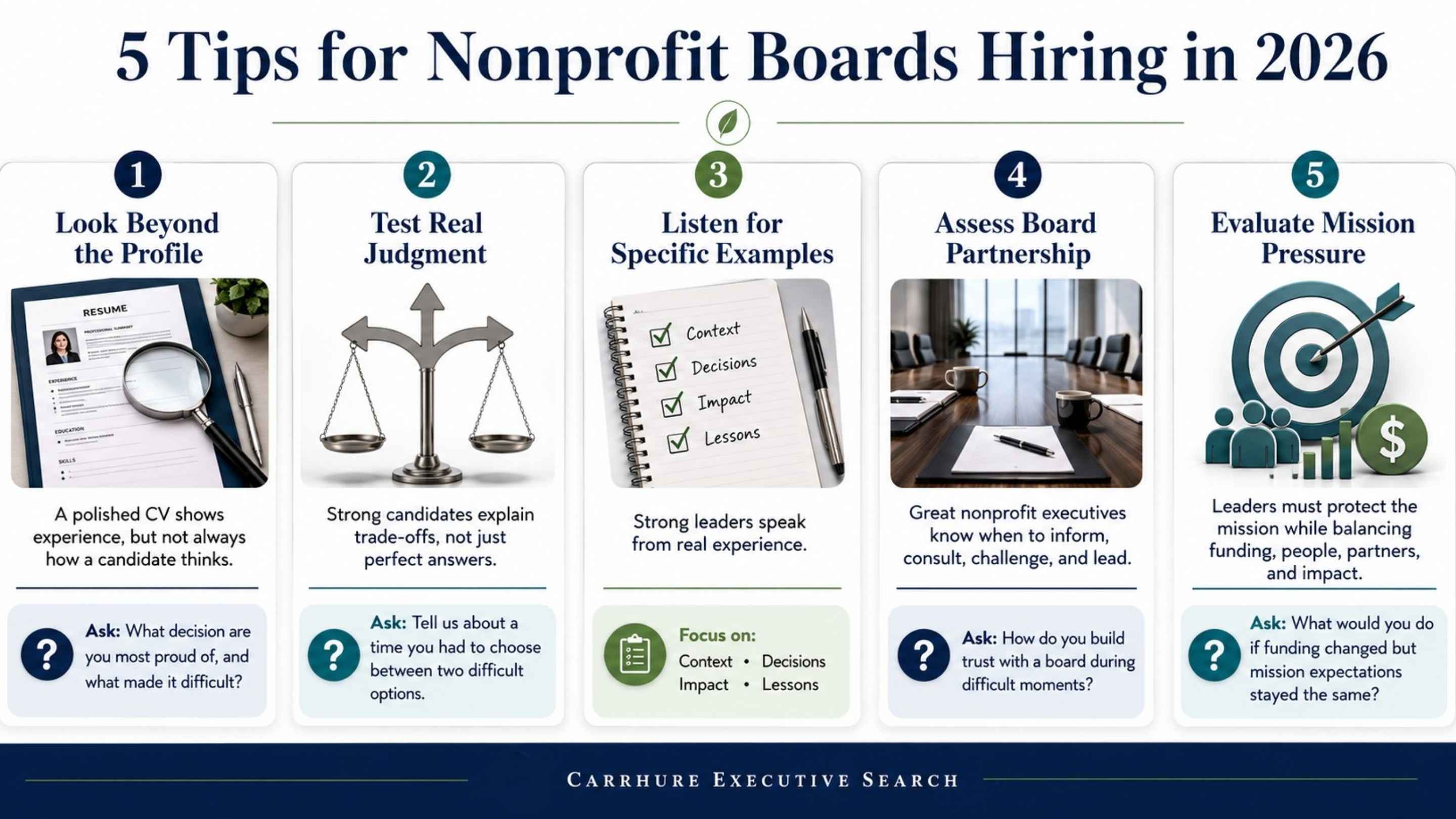
5 Tips for Nonprofit Boards Hiring in 2026
1. Look Beyond the Polished Profile
Do not stop at the CV.
A strong profile may show experience.
However, it may not show how the candidate thinks.
Boards should look for evidence behind the words.
Ask this question:
What decision are you most proud of, and what made it difficult?
This question helps reveal how the candidate thinks about pressure, responsibility, and consequences.
2. Test Real Judgment, Not Perfect Answers
Prepared answers can sound impressive.
Real judgment appears when a candidate explains trade-offs.
Boards should listen to how the candidate handled difficult choices.
Did they consider people?
Did they consider mission impact?
Did they consider risk?
Did they communicate clearly?
Ask this question:
Tell us about a time you had to choose between two difficult options.
This helps the board see whether the candidate can lead when there is no easy answer.
3. Listen for Specific Examples
Strong leaders speak from lived experience.
Weak answers often stay general.
If the candidate gives broad statements, ask for details.
Boards should listen for:
- Real context
- Clear decisions
- Stakeholder impact
- Lessons learned
- What changed after the decision
Ask this question:
What happened after you made that decision?
This helps reveal whether the candidate understands consequences.
4. Assess Board Partnership
A nonprofit executive must work well with the board.
They need to know when to inform, when to consult, when to challenge, and when to lead.
This is important because many leadership problems begin with unclear board and executive relationships.
A strong leader does not avoid the board.
A strong leader builds trust with the board.
Ask this question:
How do you build trust with a board during difficult moments?
This question helps reveal governance maturity.
5. Evaluate Mission Pressure
Nonprofit leaders often face pressure from many sides.
Funders expect results.
Teams need clarity.
Communities need support.
Boards need confidence.
Partners need trust.
The leader must protect the mission while making difficult choices.
Ask this question:
What would you do if funding changed but mission expectations stayed the same?
This question helps reveal adaptability, discipline, and mission alignment.
A Quick Checklist for Nonprofit Boards
Before making a senior hire, nonprofit boards should ask:
- Can this leader make decisions under pressure?
- Can they explain their thinking clearly?
- Can they work with the board without becoming defensive?
- Can they build trust with staff, funders, and partners?
- Can they protect the mission during uncertainty?
- Can they admit what they do not know?
- Can they adapt without losing direction?
- Can they lead beyond the words on their profile?
If the answer is unclear, the hiring risk is higher.
The Carrhure Perspective
At CARRHURE EXECUTIVE SEARCH, we believe nonprofit executive hiring should go beyond credentials.
The right leader must bring more than experience.
They must bring:
- Judgment
- Trust
- Mission alignment
- Governance maturity
- Stakeholder understanding
- Long-term impact
In the age of AI, profiles can be polished.
However, judgment must be proven.
That is why executive search today is not simply about identifying qualified candidates.
It is about helping boards understand who can truly lead when conditions change.
For mission-driven organizations, this matters deeply.
The right leader protects the mission.
The wrong leader can create cost, delay, and instability.
Why This Matters for Nonprofit Boards in 2026
Nonprofit organizations are operating in a more complex environment.
Many boards are facing funding uncertainty, leadership transitions, talent competition, stakeholder pressure, and rising expectations for accountability.
In this context, hiring based only on experience can be risky.
Boards need leaders who can think across the whole organization.
They need leaders who understand people, funding, governance, and mission.
They need leaders who can make difficult decisions without losing trust.
They need leaders who can bring stability when conditions are unstable.
This is why judgment must become a core hiring priority.
FAQ: Nonprofit Boards and Leadership Judgment
Why should nonprofit boards hire for judgment?
Nonprofit boards should hire for judgment because senior leaders often make decisions under pressure. Experience shows what someone has done, but judgment shows how they will lead when the mission is tested.
Is experience still important in nonprofit executive hiring?
Yes. Experience is still important. However, experience alone is not enough. Boards must also assess decision-making, adaptability, governance maturity, and mission alignment.
Check our previous article on The Most Valuable Skills Right Now
How can boards assess judgment during hiring?
Boards can assess judgment by asking candidates about real decisions, difficult trade-offs, mistakes, lessons learned, stakeholder impact, and how they handled pressure.
How does AI affect executive hiring?
AI can help candidates improve CVs, profiles, and interview preparation. However, AI cannot prove real leadership judgment. Boards must look beyond polished presentation and test lived experience.
What is the biggest hiring risk for nonprofit boards?
One of the biggest risks is confusing a polished candidate with a proven leader. A strong profile may look impressive, but boards must confirm how the candidate thinks, decides, and leads under pressure.
Final Thought
The best nonprofit leader in 2026 may not be the most polished candidate.
It may not be the person with the most impressive profile.
It may not be the most traditional choice.
It is the leader who can think clearly, act wisely, and protect the mission when pressure rises.
Experience matters.
However, judgment decides the outcome.
Hire for Judgment Before the Mission Feels the Cost
CARRHURE EXECUTIVE SEARCH partners with nonprofit and mission-driven organizations navigating leadership transitions, governance complexity, and high-stakes executive decisions.
We help boards identify leaders who bring experience, judgment, trust, and long-term impact.
If your organization is preparing for a senior leadership hire, contact Carrhure Executive Search today to discuss your next executive search.