

The Leadership Risk No One Talks About Enough
Leadership risks in NGOs often begin quietly. One of the most overlooked risks is poor board and CEO alignment.
The board wants stronger accountability.
The CEO wants faster decisions.
The team wants clear direction.
Funders want proof of impact.
Everyone cares about the mission.
Still, something feels stuck.
This is where board and CEO alignment in NGOs becomes a leadership risk.
It does not always look like conflict. Often, it looks like polite meetings, delayed decisions, unclear priorities, and quiet frustration.
Over time, the cost becomes visible.
Trust weakens. Staff confidence drops. Decisions slow down. The mission loses momentum.
For NGOs, board and CEO alignment is not a soft issue.
It is a leadership risk that boards must address before it affects trust, funding, and mission delivery.

What Is Board and CEO Alignment in NGOs?
Board and CEO alignment in NGOs happens when both sides share clear expectations around mission, strategy, roles, communication, and decision-making.
However, the gap appears when:
- The board moves too deeply into operations
- The CEO feels controlled instead of supported
- Strategic decisions take too long
- Board members give mixed direction
- Staff receive unclear signals from leadership
- The organization loses speed at a critical moment
At first, these issues may look small.
However, they can quietly affect funding confidence, staff morale, board trust, and mission delivery.
Therefore, board and CEO alignment in NGOs must be treated as a leadership priority.
Why Board and CEO Alignment in NGOs Matters More in 2026
NGOs are operating in a more demanding environment.
Funding is harder to predict. In addition, stakeholders expect measurable impact. Teams are stretched. Boards also face stronger pressure to govern with clarity.
As a result, board and CEO alignment in NGOs matters more than ever.
A CEO cannot lead well without board trust.
At the same time, a board cannot govern well without clear insight from the CEO.
Both sides need structure, honesty, and shared direction.
When alignment is strong, the organization moves with confidence.
However, when alignment is weak, even good strategies become hard to execute.
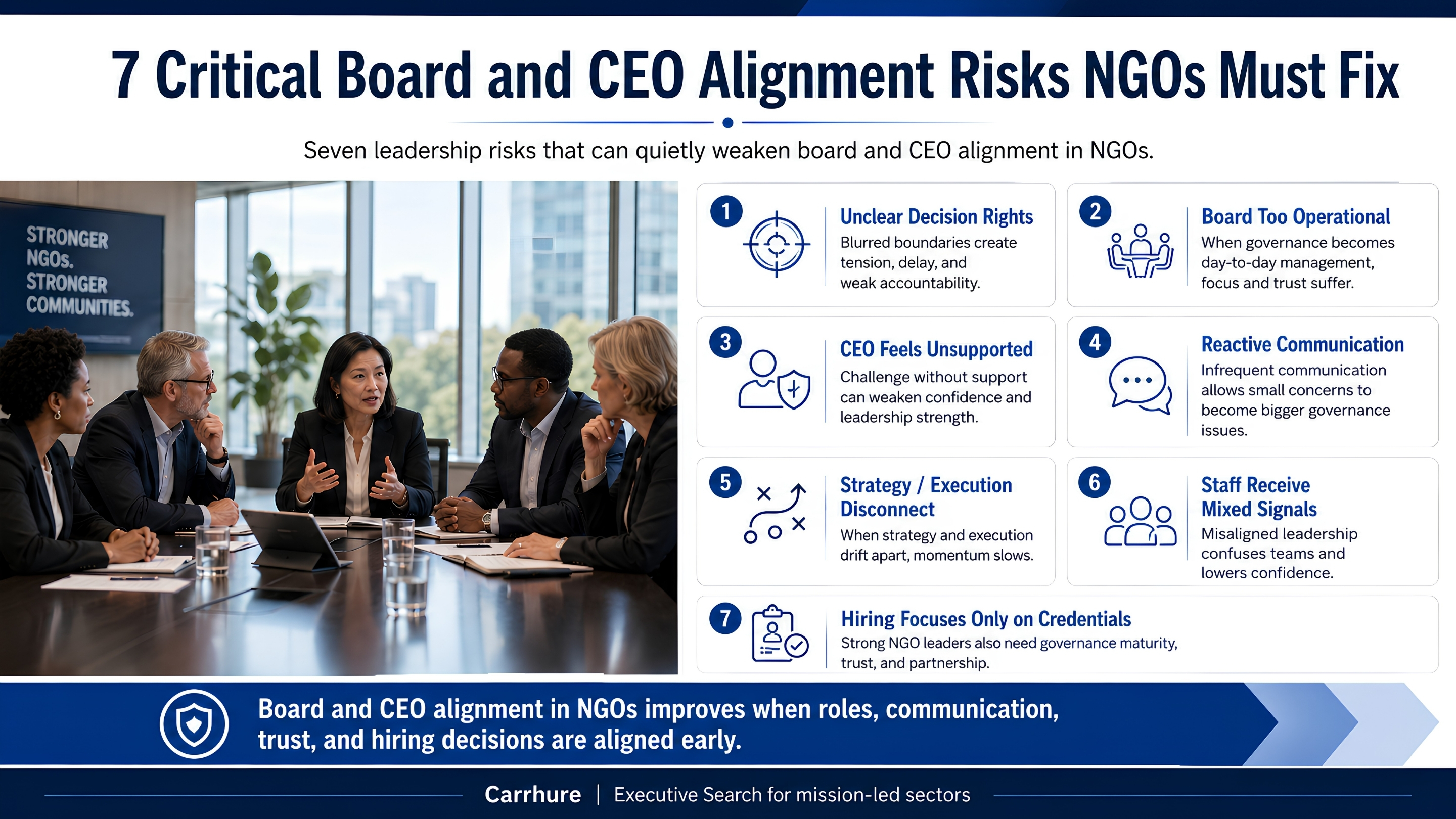
7 Critical Board and CEO Alignment Risks NGOs Must Fix
Board and CEO alignment in NGOs can weaken when leadership risks are not addressed early.
Therefore, boards and CEOs should pay close attention to these seven critical risks.
1. Unclear Decision Rights
Many board and CEO challenges begin with unclear boundaries.
For example, the board may believe it is protecting the mission.
Meanwhile, the CEO may feel blocked from leading.
The board may ask for more detail.
However, the CEO may hear doubt.
As a result, tension builds.
To fix this, NGOs must define which decisions belong to the board, which belong to the CEO, and where collaboration is required.
Ultimately, clear decision rights protect speed, trust, and accountability.
2. The Board Becomes Too Operational
Boards are responsible for governance, oversight, mission protection, and strategic accountability.
However, some boards move too deeply into operations.
When this happens, the CEO may feel watched instead of supported.
In addition, the organization risks losing strategic focus.
Boards should stay close enough to understand the organization, while remaining disciplined enough to avoid managing daily execution.
As a result, this strengthens board and CEO alignment in NGOs.
3. The CEO Feels Unsupported
A CEO can carry significant pressure.
They must lead the team, protect the mission, manage stakeholders, and deliver results.
However, if the board only challenges and rarely supports, trust can weaken.
Strong boards do more than supervise the CEO.
Instead, they create the conditions for the CEO to lead well.
That means clarity, honest feedback, timely decisions, and strategic support.
4. Communication Becomes Reactive
Strong board and CEO alignment in NGOs requires consistent communication.
However, this communication should not happen only during board meetings.
It should also happen before pressure builds.
For this reason, the CEO and board chair should have a regular communication rhythm.
This helps prevent surprises, clarify priorities, and address issues early.
When communication is weak, small concerns can become larger governance problems.
5. Strategy and Execution Become Disconnected
The board may focus on long-term strategy.
Meanwhile, the CEO may focus on immediate execution.
Both perspectives are important.
However, if these two perspectives are not connected, the organization can lose momentum.
Therefore, the board and CEO must agree on mission priorities, funding direction, stakeholder expectations, and measures of success.
Shared direction prevents confusion.
In addition, it improves board and CEO alignment in NGOs.
6. Staff Receive Mixed Signals
Staff often feel leadership misalignment before anyone names it.
For example, they may ask:
- Who is making the decision?
- Why are priorities changing?
- Are we still moving in the same direction?
- Is leadership aligned?
When staff receive mixed signals, confidence drops.
In addition, morale, retention, and execution can suffer.
For NGOs, this matters deeply because staff confidence directly affects mission delivery.
7. Executive Hiring Focuses Only on Credentials
Executive search for NGOs should not focus only on experience.
For a deeper look at the hidden risks behind nonprofit leadership decisions, read our related article: Nonprofit Boards: 5 Hidden Hiring Risks to Fix Now.
Instead, it should also assess board partnership.
The strongest candidate is not always the most impressive profile.
Rather, it is the leader who can build trust, navigate complexity, and move the mission forward with the board.
That means assessing:
- Governance maturity
- Emotional intelligence
- Stakeholder trust
- Strategic judgment
- Mission alignment
- Communication style
A strong NGO leader must know when to inform, when to consult, when to challenge, and when to lead.
Therefore, executive hiring plays a major role in board and CEO alignment in NGOs.
Carrhure’s Perspective on Board and CEO Alignment in NGOs
At CARRHURE EXECUTIVE SEARCH, we believe the board and CEO relationship is one of the strongest predictors of executive success in NGOs.
A capable CEO matters.
A committed board matters.
However, the real strength comes from how both work together.
The real question is not only:
Can this person do the job?
Instead, the better question is:
Can this leader work with the board to protect and advance the mission?
For this reason, executive hiring in NGOs should assess more than credentials.
It should also assess alignment, trust, governance maturity, and long-term impact.
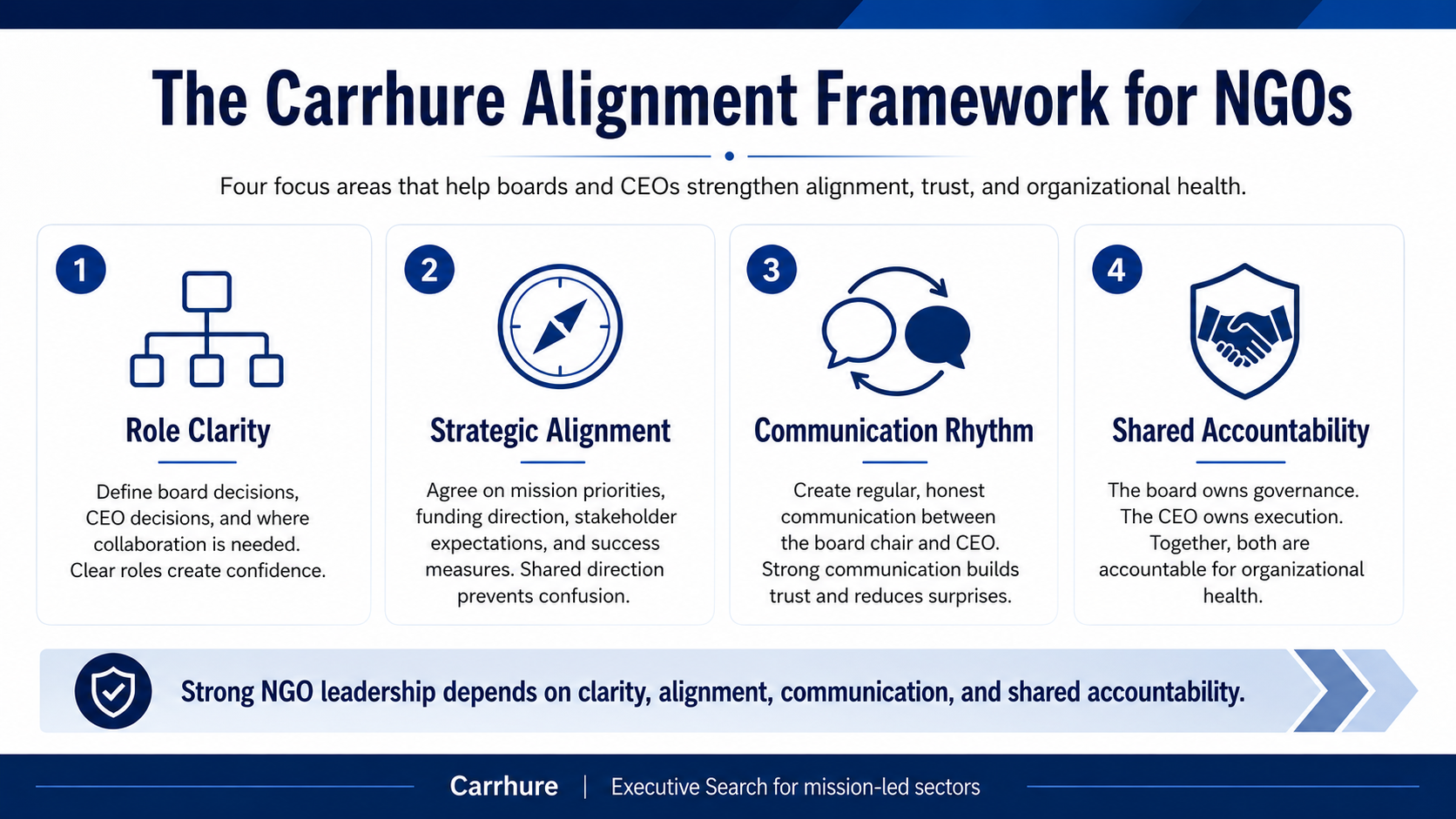
The Carrhure Alignment Framework for NGOs
To close the board and CEO alignment gap, NGOs should focus on four areas.
1. Role Clarity
First, define which decisions belong to the board, which belong to the CEO, and where collaboration is needed.
As a result, clear roles create confidence.
2. Strategic Alignment
Next, agree on mission priorities, funding direction, stakeholder expectations, and measures of success.
This way, shared direction prevents confusion.
3. Communication Rhythm
Then, create regular, honest communication between the board chair and CEO.
As a result, strong communication reduces surprises and builds trust.
4. Shared Accountability
Finally, the board is accountable for governance.
Meanwhile, the CEO is accountable for execution.
Together, they are accountable for organizational health.
How NGOs Can Improve Board and CEO Alignment
NGOs can strengthen board and CEO alignment by taking five practical steps:
- Reset expectations early
- Define decision rights clearly
- Strengthen the CEO and board chair relationship
- Review alignment, not only performance
- Hire leaders with governance maturity
These steps matter especially during executive search.
After all, the best NGO leader is not always the most impressive profile.
Instead, it is the leader who can build trust, navigate complexity, and move the mission forward with the board.
Key Takeaways on Board and CEO Alignment in NGOs
- Board and CEO alignment in NGOs is a leadership risk
- Misalignment can weaken trust, funding, staff confidence, and mission delivery
- Clear decision rights reduce friction
- Strong communication builds confidence
- Executive hiring should assess board partnership, not only experience
- Ultimately, NGOs close the gap through clarity, rhythm, trust, and shared accountability
Frequently Asked Questions
What is board and CEO alignment in NGOs?
Board and CEO alignment in NGOs means the board and CEO share clear expectations around mission, strategy, roles, decisions, communication, and accountability.
Why does board and CEO alignment in NGOs matter?
Board and CEO alignment in NGOs matters because misalignment can slow decisions, weaken trust, confuse teams, and reduce the organization’s ability to deliver its mission.
What causes board and CEO misalignment?
Common causes include unclear roles, weak communication, different expectations, blurred governance boundaries, and lack of shared priorities.
How can NGOs improve board and CEO alignment?
NGOs can improve board and CEO alignment by clarifying roles, defining decision rights, creating regular communication rhythms, and assessing alignment during hiring and performance reviews.
Why should executive hiring assess board partnership?
Executive hiring should assess board partnership because NGO leaders must work effectively with the board to protect trust, strengthen governance, and move the mission forward.
Final Thought on Board and CEO Alignment in NGOs
The board and CEO relationship is one of the most important leadership systems inside any NGO.
When it works, the organization gains clarity.
It gains confidence.
It also gains momentum.
However, when it weakens, the mission feels the pressure.
Strong board and CEO alignment in NGOs does more than improve relationships.
Ultimately, it strengthens the mission.
Build Stronger Board and CEO Alignment Before the Gap Becomes Costly
CARRHURE EXECUTIVE SEARCH partners with NGOs and mission-driven organizations navigating leadership transitions, governance complexity, and high-stakes executive decisions.
Through strategic executive search, we help boards identify leaders who bring capability, alignment, trust, and long-term impact.
Contact Carrhure Executive Search today to discuss your next executive leadership search.