

Hiring is no longer just about filling a position.
In 2026, leadership hiring strategy has become a critical business decision for organizations navigating uncertainty and change.
The organization had a vacancy.
On paper, the next step looked simple.
Define the role. Launch the search. Review candidates. Make the hire.
But the board knew it was no longer that simple.
The environment had changed.
Budgets were shifting.
Stakeholder expectations were rising. Teams needed clarity. The future was harder to predict.
So the real question was no longer:
“Who can fill this role?”
The better question was:
“Who can lead this organization through what comes next?”
That is why organizations need a stronger leadership hiring strategy in 2026.
Because hiring today is not only about capability.
It is about adaptability, trust, judgment, and long-term resilience.
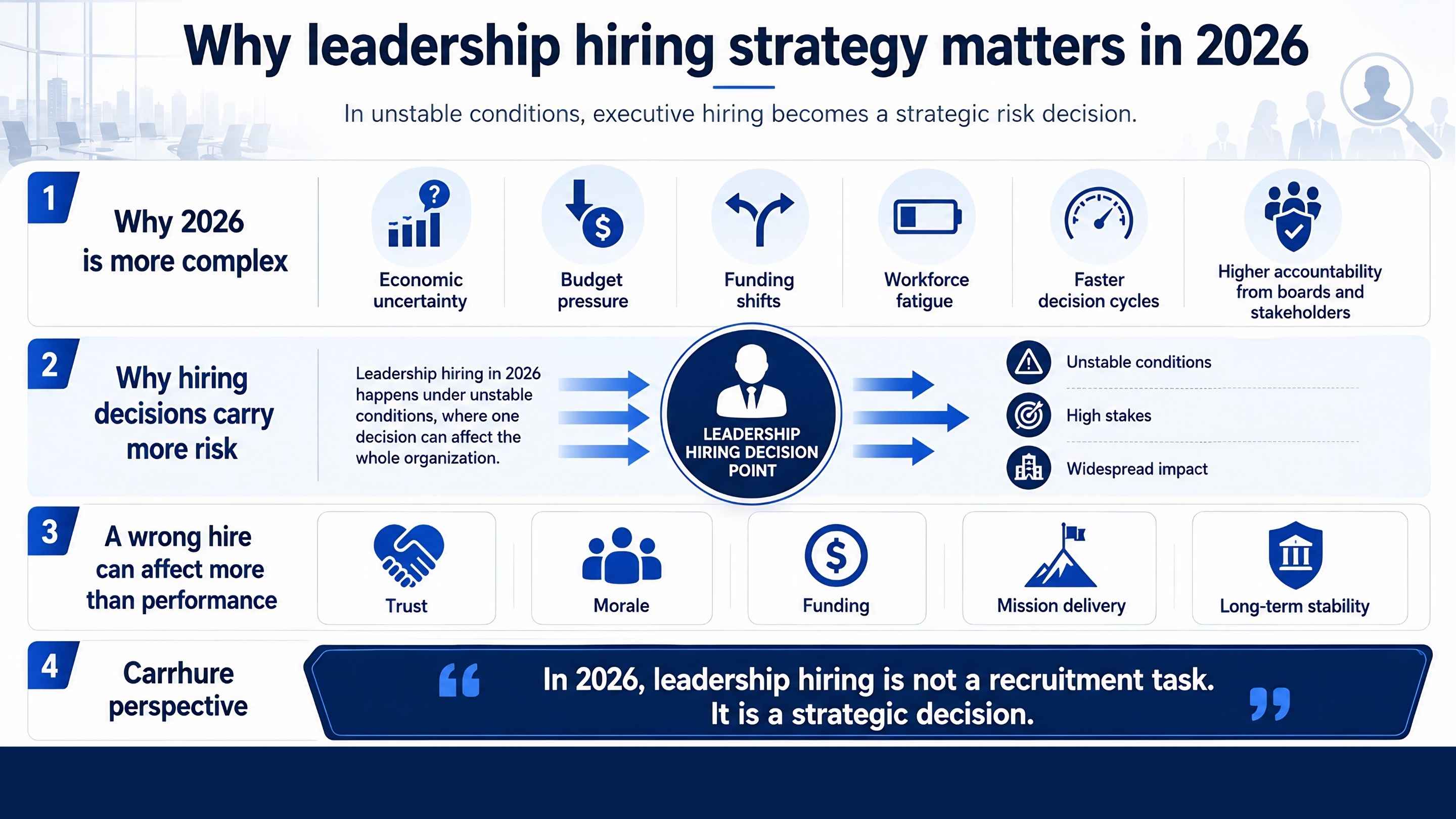
Why Leadership Hiring Strategy Matters in 2026
Leadership hiring in 2026 is more complex because organizations are operating in unstable conditions.
Today, many organizations face:
- Economic uncertainty
- Budget pressure
- Funding shifts
- Workforce fatigue
- Faster decision cycles
- Higher accountability from boards and stakeholders
As a result, hiring decisions now carry more risk.
A wrong hire can affect performance. However, the impact does not stop there.
It can also affect trust, morale, funding, mission delivery, and long-term stability.
Therefore, leadership hiring in 2026 is no longer just a recruitment task.
It is a strategic decision.
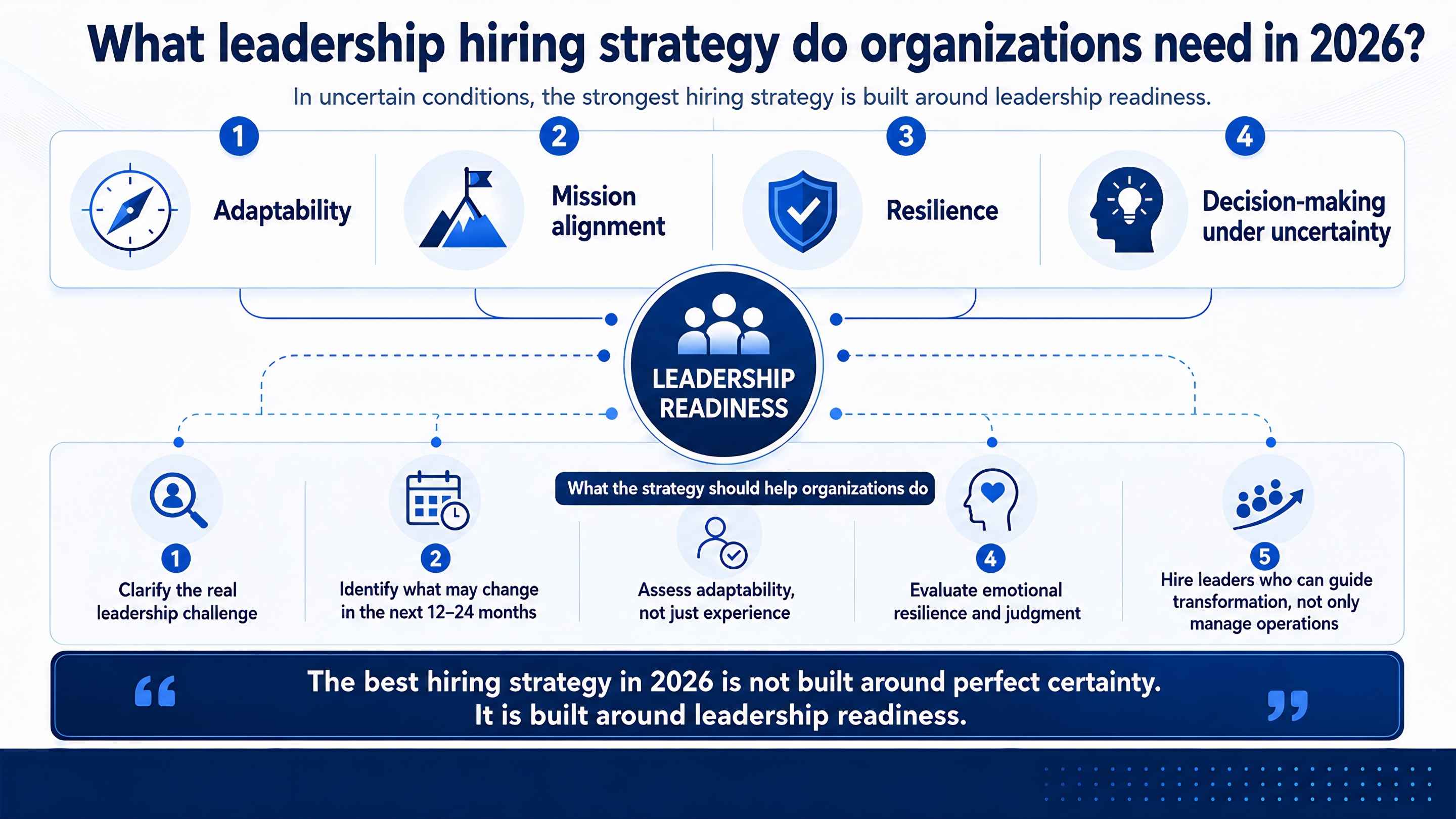
What Leadership Hiring Strategy Do Organizations Need in 2026?
Organizations need a leadership hiring strategy that focuses on adaptability, mission alignment, resilience, and decision-making under uncertainty.
In other words, the goal is not only to find a qualified leader. It is to find a leader who can move the organization forward when conditions change.
A strong hiring strategy should help organizations:
- Clarify the real leadership challenge
- Identify what may change in the next 12–24 months
- Assess adaptability, not just experience
- Evaluate emotional resilience and judgment
- Hire leaders who can guide transformation, not only manage operations
As a result, the best hiring strategy in 2026 is not built around perfect certainty.
Instead, it is built around leadership readiness.
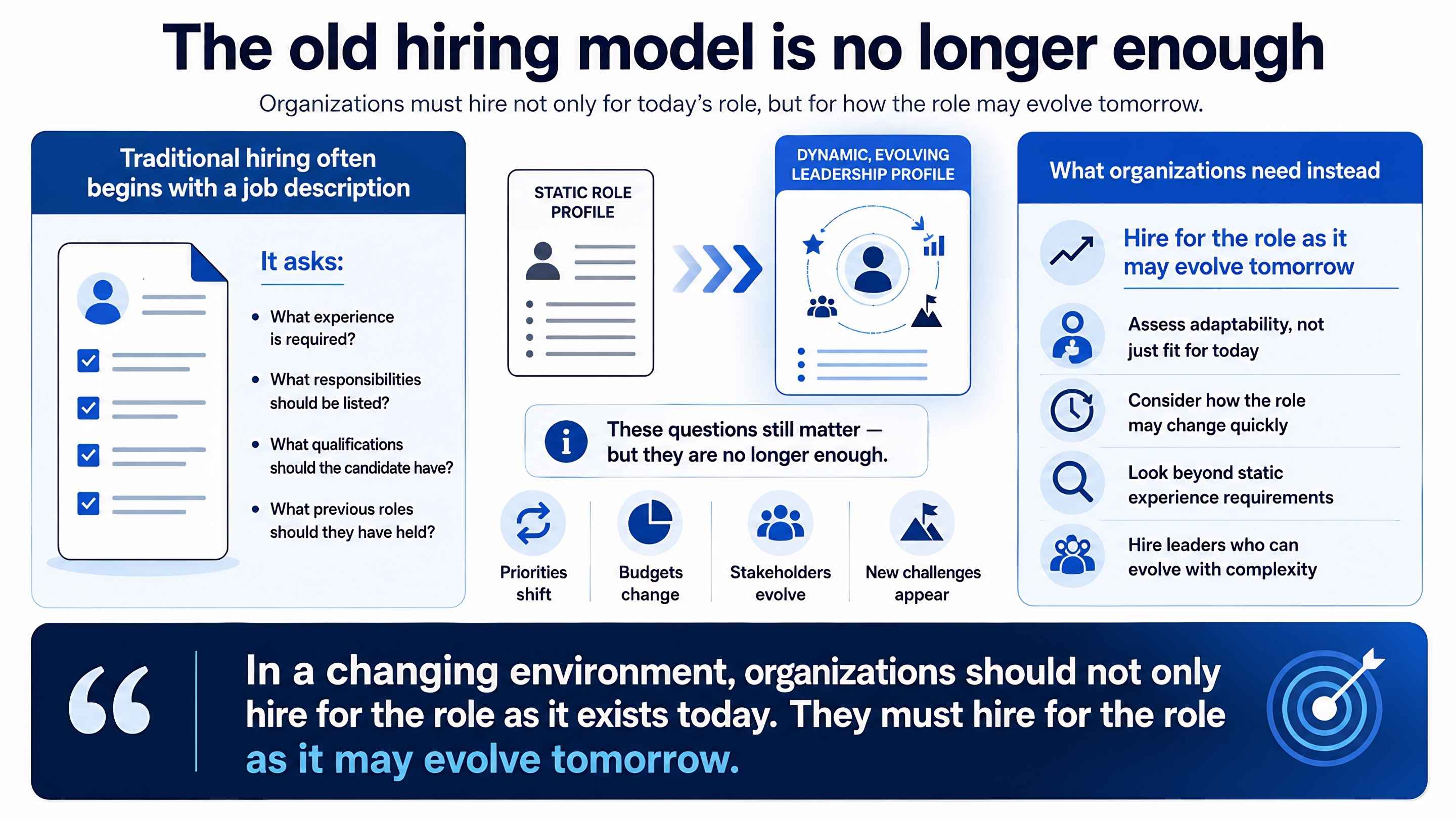
The Old Hiring Model Is No Longer Enough
Traditional hiring often begins with a job description.
It usually asks:
- What experience is required?
- What responsibilities should be listed?
- What qualifications should the candidate have?
- What previous roles should they have held?
These questions still matter. However, they are no longer enough.
In a changing environment, job descriptions can become outdated quickly.
For example, priorities shift. Budgets change. Stakeholders evolve. New challenges appear.
As a result, organizations should not only hire for the role as it exists today.
They must also hire for the role, as it may evolve tomorrow.
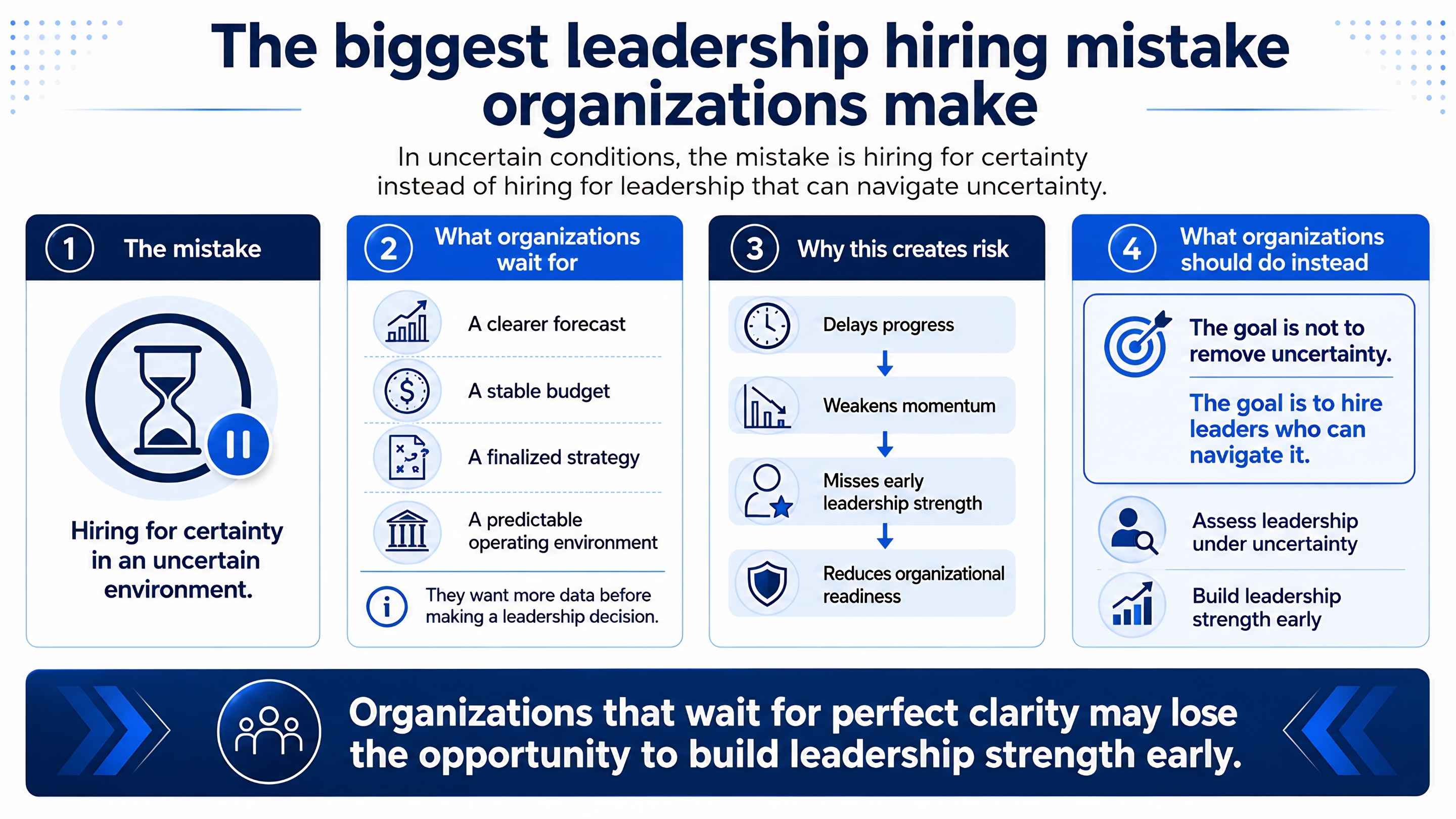
The Biggest Leadership Hiring Mistake Organizations Make
The biggest mistake is hiring for certainty in an uncertain environment.
Many organizations wait for more data before making a leadership decision.
They often want:
- A clearer forecast
- A stable budget
- A finalized strategy
- A predictable operating environment
However, waiting for complete certainty can slow progress.
In unstable times, the goal is not to remove uncertainty. Instead, the goal is to hire leaders who can navigate it.
As a result, organizations that wait for perfect clarity may miss the chance to build leadership strength early.
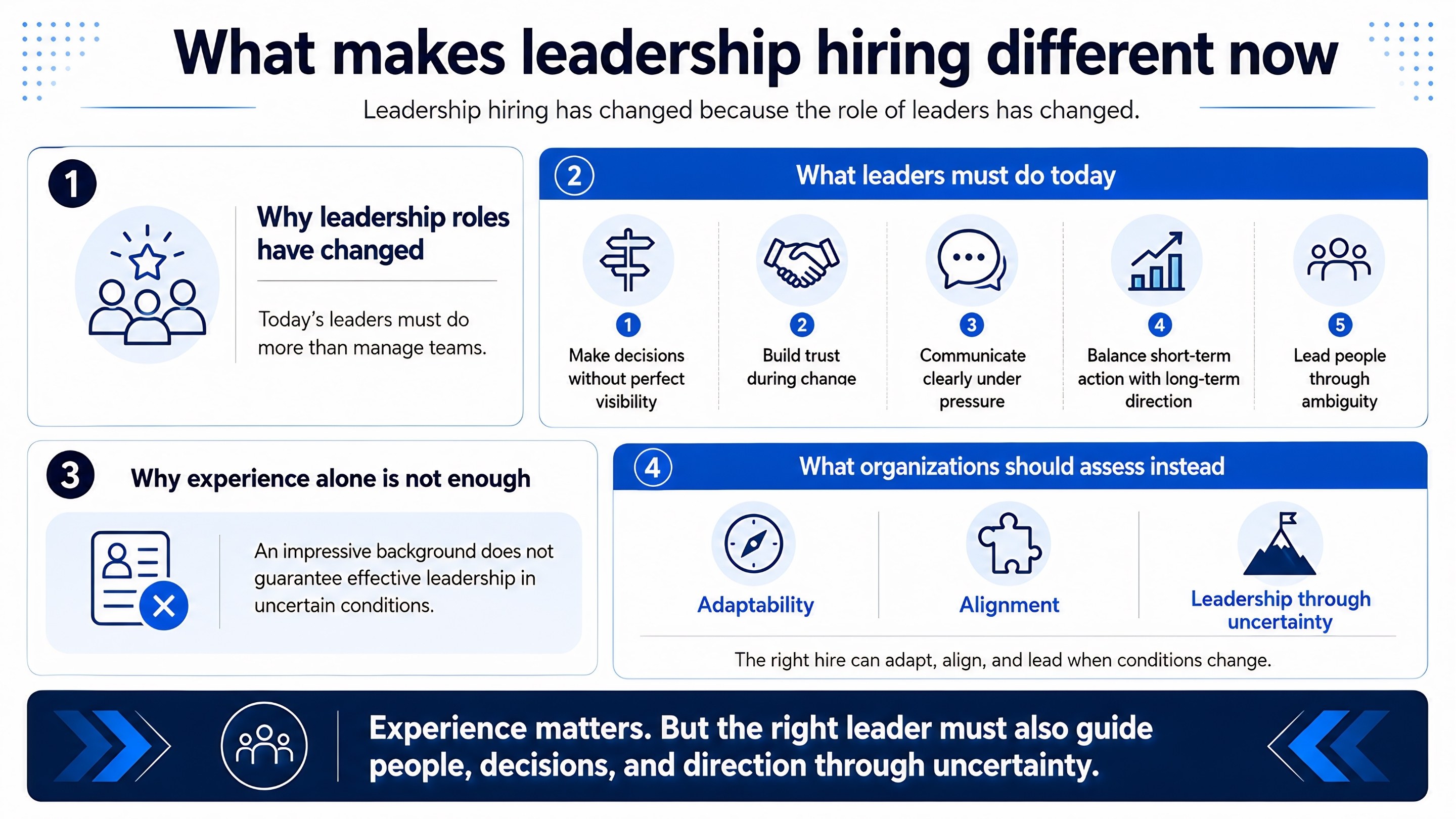
What Makes Leadership Hiring Different Now
Leadership hiring has changed because the role of leaders has changed.
Today’s leaders must do more than manage teams. They must also guide organizations through uncertainty, pressure, and change.
This means they need to:
- Make decisions without perfect visibility
- Build trust during change
- Communicate clearly under pressure
- Balance short-term action with long-term direction
- Lead people through ambiguity
Therefore, experience alone is no longer enough.
A candidate may have an impressive background. However, if they cannot adapt, align, and lead through uncertainty, they may not be the right hire.
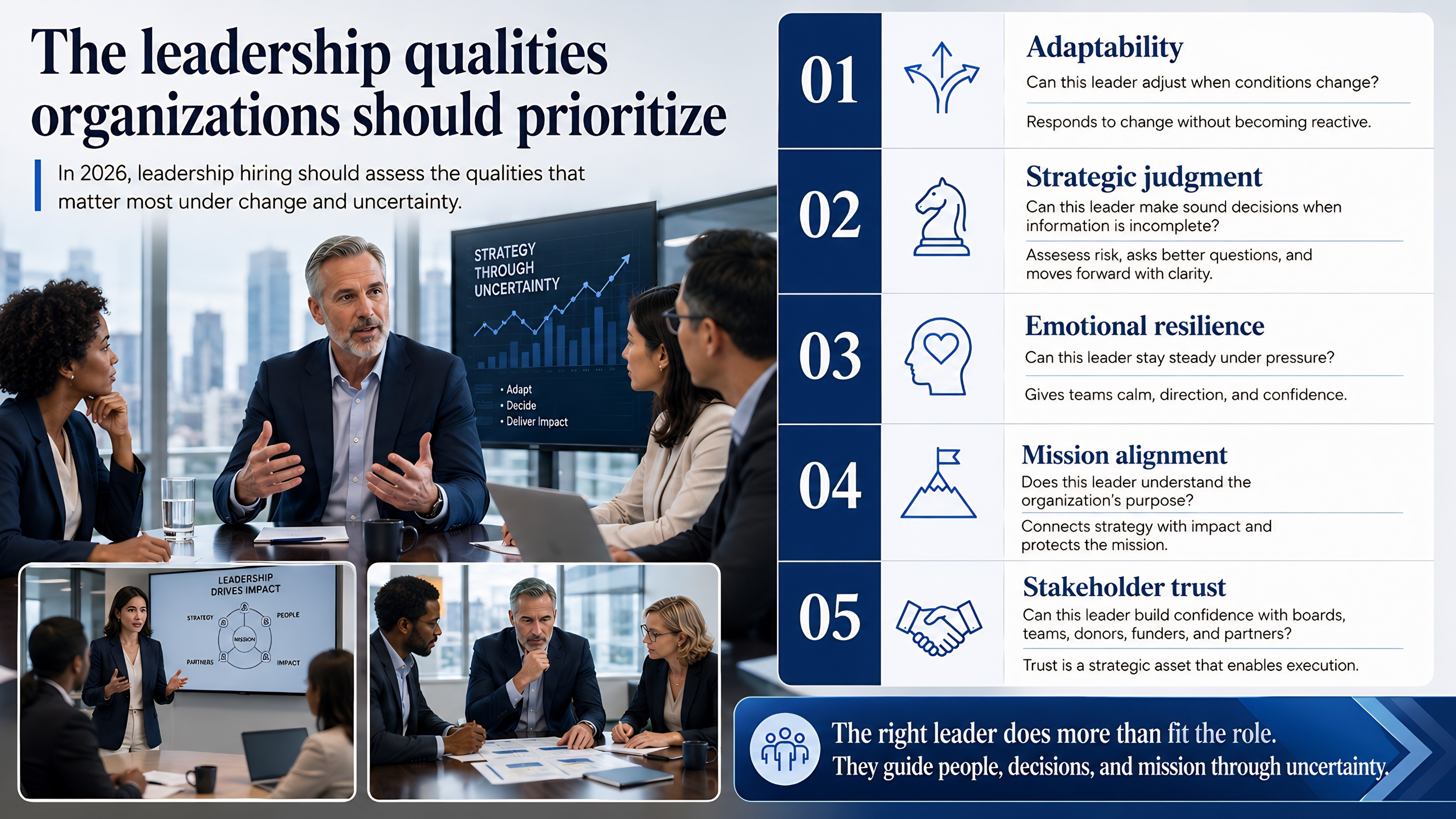
The Leadership qualities organizations should prioritize
A powerful leadership hiring strategy in 2026 should evaluate qualities that are often missing from traditional job descriptions.
1. Adaptability
Can this leader adjust when conditions change?
Can they respond without becoming reactive?
Adaptability is critical because many organizations are no longer operating from fixed plans. They are adjusting in real time.
2. Strategic judgment
Can this leader make sound decisions when information is incomplete?
Strong leaders do not wait for perfect data.
They know how to assess risk, ask better questions, and move forward with clarity.
3. Emotional resilience
Can this leader stay steady under pressure?
In uncertain environments, teams look to leaders for calm, direction, and confidence.
A leader who loses stability can weaken the entire organization.
4. Mission alignment
Does this leader understand the organization’s purpose?
For mission-driven organizations, leadership must connect strategy with impact.
The right leader should not only perform the role.
They should protect and advance the mission.
5. Stakeholder trust
Can this leader build confidence with boards, teams, donors, funders, and partners?
Trust is a strategic asset.
Without trust, even strong strategies become harder to execute.
Carrhure’s perspective
The strongest leadership hiring strategy is not about finding the perfect profile. It is about identifying the leader who can succeed in the real context of the organization.
At CARRHURE EXECUTIVE SEARCH, we partner with organizations facing complexity, urgency, and transition.
We believe executive hiring should not be treated as a transactional process.
Instead, it should be treated as a strategic advisory decision.
This means helping organizations understand:
- What leadership challenge are they really solving
- What kind of leader will the future require
- Which risks must be reduced before the hire is made
- How to evaluate candidates beyond credentials
For organizations working in biodiversity, agriculture, climate resilience, health, international development, and other mission-led sectors, leadership decisions carry long-term impact.
Therefore, the right hire can strengthen trust, direction, and mission delivery.
However, the wrong hire can slow everything down.
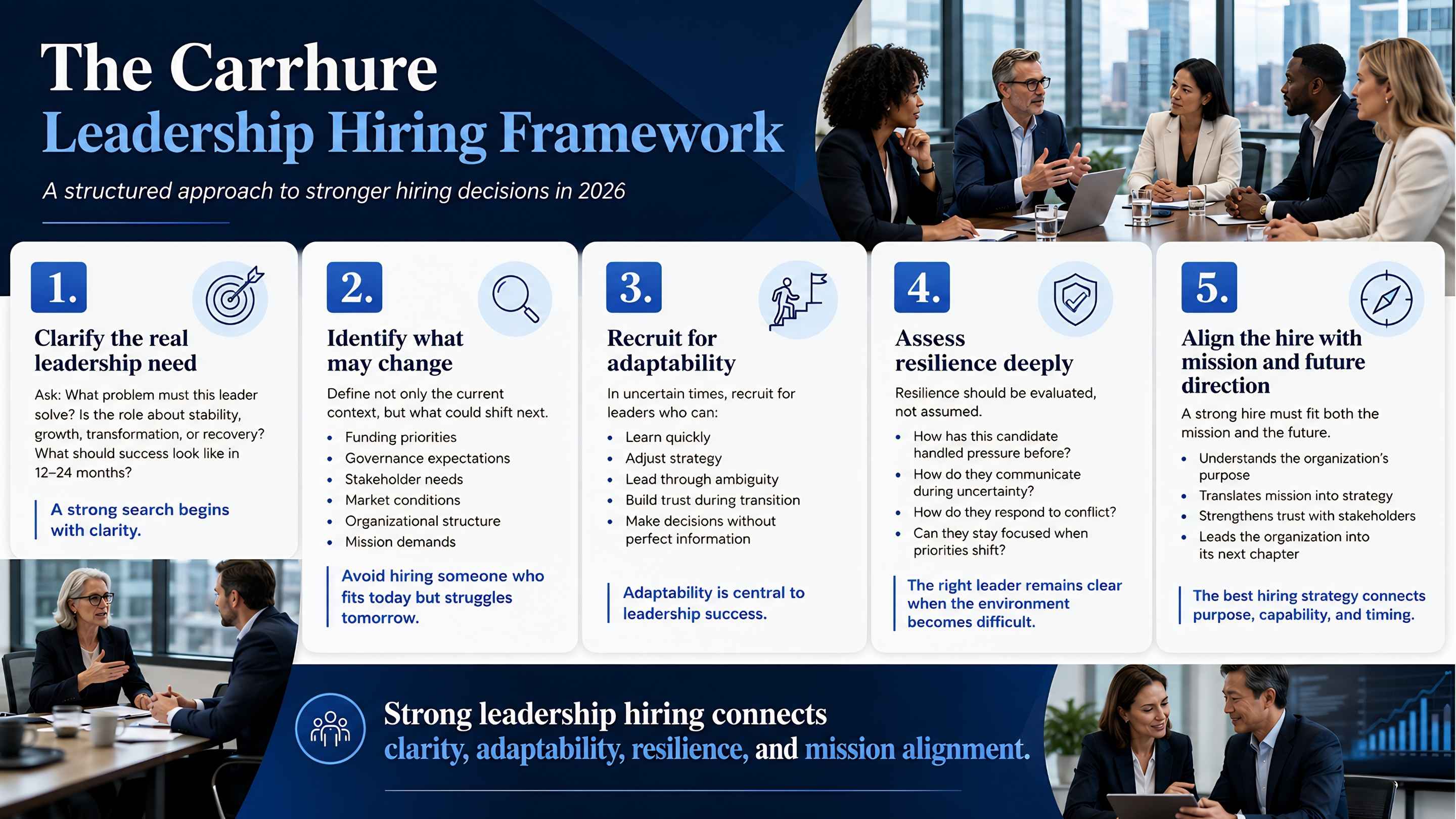
The Carrhure Leadership Hiring Framework
To make stronger hiring decisions in 2026, organizations should use a structured framework.
1. Clarify the real leadership need
Before launching the search, ask:
- What problem must this leader solve?
- Is this role about stability, growth, transformation, or recovery?
- What will success look like in 12–24 months?
A strong search begins with clarity.
Without clarity, organizations risk hiring for the wrong problem.
2. Identify what may change
Organizations must not only define the current context.
They must also identify what could shift.
This includes:
- Funding priorities
- Governance expectations
- Stakeholder needs
- Market conditions
- Organizational structure
- Mission demands
This helps avoid hiring someone who fits today but struggles tomorrow.
3. Recruit for adaptability
In stable times, organizations often recruit for an exact fit.
In uncertain times, they must recruit for adaptability.
This means looking for leaders who can:
- Learn quickly
- Adjust strategy
- Lead through ambiguity
- Build trust during transition
- Make decisions without perfect information
Adaptability is no longer optional.
It is central to leadership success.
4. Assess resilience deeply
Resilience should not be assumed.
It should be evaluated.
Organizations should ask:
- How has this candidate handled pressure before?
- How do they communicate during uncertainty?
- How do they respond to conflict?
- Can they stay focused when priorities shift?
The wrong leader may perform well in stability but struggle under pressure.
The right leader remains clear when the environment becomes difficult.
5. Align the hire with the mission and future direction
A strong hire must fit both the mission and the future.
That means asking:
- Does this leader understand the organization’s purpose?
- Can they translate mission into strategy?
- Will they strengthen trust with stakeholders?
- Can they lead the organization into its next chapter?
The best leadership hiring strategy connects purpose, capability, and timing.

Why Organizations Need Strategic Advisory, Not Just Recruitment
In 2026, organizations need more than a list of candidates.
They need guidance.
More importantly, they need a partner who can help them interpret leadership risk, challenge assumptions, and make better decisions.
Strategic executive search should help organizations:
- Understand the market
- Define the role more accurately
- Identify hidden leadership risks
- Evaluate candidate adaptability
- Protect the organization from misalignment
As a result, executive search becomes more than recruitment.
It becomes decision support.
How Leadership Hiring Affects Long-Term Stability
A leadership hire can shape an organization for years.
The right leader can:
- Improve decision-making
- Strengthen team confidence
- Build stakeholder trust
- Support funding conversations
- Advance the mission with clarity
However, the wrong hire can create:
- Confusion
- Delays
- Misalignment
- Internal tension
- Loss of momentum
Therefore, leadership hiring should never be rushed or treated as an administrative task.
It is one of the most important strategic decisions an organization can make.
What Boards and CEOs Should Ask Before Hiring
Before making a leadership hire, boards and CEOs should ask:
- Are we hiring for today’s role or tomorrow’s reality?
- What uncertainty must this leader be able to handle?
- What leadership qualities are not written in the job description?
- What would make this hire fail?
- What kind of leader will strengthen trust and stability?
These questions help organizations move beyond credentials.
They also reveal whether the candidate can truly lead in context.
Key takeaways
- Leadership hiring in 2026 requires strategy, not just recruitment
- Organizations must hire for adaptability, resilience, and judgment
- Waiting for perfect certainty can delay important leadership decisions
- Job descriptions are not enough in a changing environment
- The right leader must fit the mission, the context, and the future
- Executive search should function as a strategic advisory and decision support
Frequently Asked Questions
What is a leadership hiring strategy?
A leadership hiring strategy is a structured approach to identifying, assessing, and selecting leaders who can meet the organization’s current and future needs.
Why is leadership hiring harder in 2026?
Leadership hiring is harder because organizations face uncertainty, faster change, funding pressure, workforce challenges, and higher stakeholder expectations.
What should organizations look for in leaders today?
Organizations should look for adaptability, strategic judgment, emotional resilience, mission alignment, and the ability to build stakeholder trust.
Why is adaptability important in executive hiring?
Adaptability matters because leaders must make decisions and guide organizations even when conditions change or information is incomplete.
Final thought
The future will not wait until every data point is clear.
Organizations still need to act.
They still need to decide.
They still need leaders who can move forward with judgment, clarity, and courage.
That is why the most powerful leadership hiring strategy in 2026 is not about finding someone who fits a fixed environment.
It is about finding someone who can lead when the environment changes.
Make stronger leadership hiring decisions in 2026
CARRHURE EXECUTIVE SEARCH partners with organizations navigating uncertainty, complexity, and leadership transition.
We help boards and leadership teams identify executive leaders who bring clarity, resilience, and long-term impact.
Contact Carrhure Executive Search today to discuss your leadership hiring strategy.